Audience Lab By Attractr

Production Intelligence Readiness Quiz

The Pioneer Track: From Post-Hoc Reporting to Predictive Revenue

Written by

Read time

Date

The Efficiency Ceiling

You’re a high-stakes leader. Serious budgets. Professional execution. Consistent results.

But you have a blind spot—and it’s getting more expensive every season.

The pattern:

  • Commission work 12-18 months out ($50K-$500K)
  • Execute flawlessly (production, marketing, logistics)
  • Hit acceptable numbers (60-75% capacity, breakeven or modest loss)
  • But you can’t explain why some shows work and others don’t
  • You manage risk, but not predictively
  • You generate zero revenue from your 12-18 month production process
  • Your team uses scattered tools with no unified infrastructure

If you scored 71-100 on the Production Intelligence Readiness Quiz, you’re a Pioneer—and you’ve maxed out operational excellence.

Your team is strong. Your systems are solid.

But you’re still guessing on the most expensive decision: what to make.

And you’re missing the biggest opportunity: Turning your commissioning, planning, and development into audience experiences that generate $25,000-100,000 annually in pre-revenue, consolidate team workflows, and validate demand 12-18 months early.

What Is the Pioneer Track?

Pioneers are performing arts leaders who:

  • Manage $800K-$4M+ annual budgets
  • Make 6-12 high-stakes production decisions per year
  • Execute flawlessly but can’t predict which shows will succeed
  • Have dashboards full of performance metrics (revenue, attendance, retention)
  • Lack decision intelligence (predictive signals, willingness-to-pay data, sentiment before commitment)
  • Don’t monetize their 12-18 month production process (only final shows)
  • Need unified platform infrastructure to scale collaboration + monetization + validation

You’re a Pioneer if:

  • You’re an Artistic Director, Executive Director, or Senior Producer
  • Your board requires data before approving commissions
  • You commission work 12-18 months in advance
  • You need to forecast revenue before you commit six-figure budgets
  • You want to generate substantial pre-revenue from your production lifecycle
  • Your team needs consolidated infrastructure (not 15+ scattered tools)

You’re NOT failing. You’re optimizing the past—and 2019 playbooks won’t solve 2026 problems. And you’re giving away millions in potential process revenue.

The Pattern: Post-Hoc Reporting Without Process Monetization

The Three Feelings That Define Pioneers

  1. “We spent $200K on a world premiere that sold 85%. But we didn’t monetize the 12-month development—just the final run.”
    • You don’t know WHY it worked (or why it struggled)
    • You can’t engineer repeatability
    • You left $10,000-50,000 on the table by not monetizing your commission process
  2. “Our subscribers are aging out—but we don’t know what younger audiences want until we produce it. And we’re not involving them in our planning process.”
    • You’re reacting to demographic shifts, not anticipating them
    • By the time you see the pattern, it’s too late
    • Your season planning process could generate $25,000+ annually if you invited audiences in
  3. “The board wants data before approving the commission. But we don’t have data until after we spend the money. And we generate zero revenue before opening night.”
    • The catch-22 that forces you to take blind risks
    • You report on outcomes, not inputs
    • You’re missing the paradigm: your production process IS monetizable

The brutal truth: You have dashboards full of performance metrics (revenue, attendance, donor retention).

What you don’t have:

  • Decision intelligence (predictive signals, willingness-to-pay data, sentiment before commitment)
  • Process monetization infrastructure (turn 12-18 months into revenue streams)
  • Unified collaboration workspace (consolidate 15+ scattered tools)

The Shift: Concept → Monetize → Validate → Leverage

Most organizations confuse measurement with intelligence.

  • Performance metrics explain the past.

  • Decision intelligence reduces future uncertainty.

The Pioneer Shift:
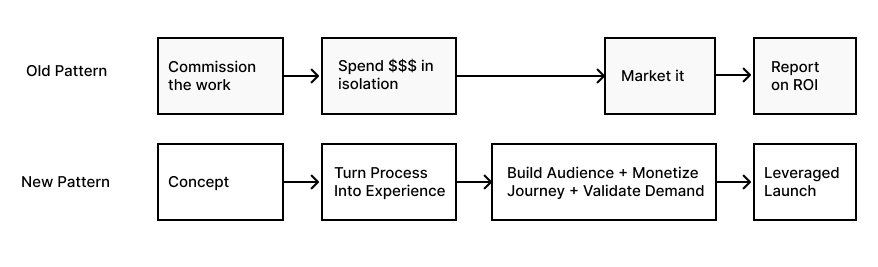
Example: The Pre-Production Pulse + Season Preview Live Room

Before committing to a major commission or revival, you run a Pre-Production Pulse with your top 5% (donors, loyal subscribers, board influencers)—AND turn your planning process into audience experience.

Step 1: Create Show Page (Validation)

Create a Show Page (working title, 200-word concept, director/cast if known, sample creative).

Send a private link to 200 high-value stakeholders:
“We’re considering this for next season. React honestly.”

The signals:

  • Excitement score (1-10: “How excited are you?”)
  • Intent to buy (“Would you purchase opening night tickets today?”)
  • Willingness to pay (“What’s a fair ticket price?”)
  • Demographic gaps (Who’s NOT excited? What age/geography is missing?)

Step 2: Host Season Preview Live Room (Monetization—The Paradigm Shift)

Charge $25 for a 90-minute behind-the-scenes session where you:

  • Walk through your top 3 concepts
  • Share your artistic vision and season strategy
  • Answer questions live
  • Collect real-time feedback

Revenue: 80 attendees × $25 = $2,000 pre-revenue from your planning process

Step 3: Make Board-Ready Decision (The Triple Win)

The decision (4-quadrant matrix):

  • High excitement + high intent → Green light (move to full production)
  • High excitement + low intent → Reframe (pricing, format, or casting issue)
  • Low excitement + niche high intent → Limited run (target that niche, don’t scale)
  • Low excitement + low intent → Pivot or shelve (save $200K for a concept with proof)

You just:

  1. Generated $2,000 from your planning process (not just the final show)
  2. Validated demand before committing $200K
  3. Turned season planning into audience experience (monetization + collaboration + validation)

You moved the moment of truth from Box Office Reports to Concept Validation—and generated pre-revenue.

Pioneer-Level Experiments

Experiment 1: The Pre-Production Pulse + Process Monetization

What it is:
A 24-hour sentiment test with your top 5% stakeholders before you commit a six-figure budget—PLUS monetize the testing process itself.

Who to ask:

  • Donors ($1K+ annual)
  • Subscribers (3+ years)
  • Board members
  • Artistic advisors

What to send:
A Google Form or Typeform:

  1. “Here’s the concept (150 words + image)”
  2. “Rate your excitement (1-10)”
  3. “Would you buy tickets in the first week? (Yes/Maybe/No)”
  4. “What concerns you most about this concept?”
  5. NEW: “Would you pay $15-25 to attend a live session where we discuss our season planning process and gather your input?”

Why this works:
These are your believers. If they’re not excited, your general audience won’t be either.

AND: If 30% say yes to the live session, that’s $450-750 in pre-revenue from ONE concept test + validation data for your board.

Time: 1 day (setup + 24-hour window)
What you get:

  • Go/no-go signal that protects your six-figure budget
  • Process monetization validation ($450-750 immediate revenue)
  • Board-ready recommendation with demand data

Experiment 2: The Commission Development Series

What it is:
For $100K+ commissions, create a 6-month Live Room series inviting donors into the development process.

Structure:

  • Session 1: “Meet the Playwright” (artistic vision, concept, themes)
  • Session 2: “Casting Deep Dive” (how we choose actors, chemistry tests)
  • Session 3: “Design Reveal” (set models, costume sketches, lighting concepts)
  • Session 4: “First Rehearsal Access” (table read, first blocking)
  • Session 5: “Tech Week Insights” (technical theatre behind-the-scenes)
  • Session 6: “Pre-Opening Night Q&A” (final prep, expectations)

Pricing:

  • $25/session (individual)
  • $120 for full series (20% discount)

Revenue potential:

  • 100 series subscribers × $120 = $12,000 pre-revenue
  • Board presentation: “We pre-funded 12% of this commission through audience engagement”

Time: 2 hours/session, 6 sessions over 6 months
What you get:

  • $12,000 pre-revenue from commission process
  • Engaged donor base BEFORE opening night
  • Validation signals throughout development (pivot if needed)
  • Board-ready narrative: “Audience-backed commission”

Experiment 3: The “Insider’s Circle” Annual Membership

What it is:
A year-round Live Room membership for your top 5-10% donors/subscribers.

What’s included:

  • Monthly “Artistic Director’s Briefing” (30-min live sessions)
  • Quarterly season planning previews
  • Exclusive casting announcements
  • Behind-the-scenes rehearsal access (2-3 times/season)
  • Early ticket access
  • Private Slack/Discord community

Pricing:

  • $50/month or $500/year

Revenue potential:

  • 50 members × $500 = $25,000 annual pre-revenue
  • 100 members × $500 = $50,000 annual pre-revenue

Target audience: Top 5% donors, long-term subscribers, board members

Time: 4-5 hours/month (one live session + community engagement)
What you get:

  • $25,000-50,000 annual revenue from your production process
  • Year-round audience engagement (not just at opening)
  • Built-in validation mechanism (test concepts with Insiders first)
  • Consolidated community infrastructure (not scattered across email/social)

Experiment 4: The Board-Proof Validation Report

What it is:
A data-backed recommendation for your board using predictive sentiment (not post-hoc performance metrics).

Structure:

  1. Concept Summary (200 words)
  2. Validation Results (Pulse data: excitement score, intent to buy, demographic breakdown)
  3. Risk Assessment (4-quadrant matrix: where does this concept land?)
  4. Process Revenue Generated ($2,000 from Season Preview Live Room, $450 from Pulse testing)
  5. Recommendation (Green light / Reframe / Limited run / Pivot)
  6. Financial Projection (If 200 stakeholders show 8/10 excitement + 60% intent, forecast: [revenue model])

Why this works:
Boards trust data. This gives them proof BEFORE you spend. Plus you demonstrate revenue generation from the decision process itself.

Time: 2-3 hours after running a Pulse
What you get:

  • Unanimous board approval based on evidence, not instinct
  • Proof that your production process generates revenue

Experiment 5: The Revenue Forecast Model

What it is:
A predictive formula to forecast ticket sales 8-12 weeks out (not 2 weeks out).

Formula:

Projected Revenue = (# of "Yes" responses) × (Avg ticket price) × (Historical conversion rate) + (Process revenue already generated)

Example:

  • 200 stakeholders surveyed
  • 120 said “Yes, I’d buy opening night”
  • Avg ticket price: $45
  • Historical conversion: 50% (half who say yes actually buy)
  • Process revenue: $2,000 (from Season Preview Live Room)

Projection: (120 × $45 × 0.5) + $2,000 = $4,700 total revenue before marketing begins

The decision:
If projection is below breakeven, you reframe marketing or add urgency tactics BEFORE you launch. But you’ve already generated $2,000 from your process.

Time: 1 hour to set up formula, 48 hours to collect data
What you get:

  • Revenue forecast 8-12 weeks out (when you can still pivot)
  • Process revenue that offsets risk

Implementation Roadmap

Phase 1: Run Your First Pre-Production Pulse + Test Process Monetization (Week 1-2)

Goal: Test one upcoming concept with your top 5% + validate if they’d pay for process access

Steps:

  1. Pick your next big decision (commission, revival, new format)
  2. Write a 200-word concept + add sample creative (image, video, design mockup)
  3. Survey 200 high-value stakeholders (Google Form or Typeform)
  4. Add question: “Would you pay $25 for a 90-minute live session where we discuss our season planning and gather your input?”
  5. Analyze results using 4-quadrant matrix
  6. If 30%+ say yes: Schedule and host your first Season Preview Live Room

Success metric:

  • Clear go/no-go decision based on data, not gut
  • $500-2,000 in process revenue from first test

Phase 2: Present to Board with Process Revenue Proof (Week 3)

Goal: Get board approval based on predictive sentiment + demonstrated process monetization

Steps:

  1. Create Board-Proof Validation Report (use template)
  2. Present: “We tested this concept with 200 stakeholders. Here’s what they said.”
  3. Show 4-quadrant matrix (visual proof of where concept lands)
  4. Highlight: “We generated $2,000 from the testing process itself—demonstrating audience willingness to engage and pay.”
  5. Make recommendation: Green light / Reframe / Pivot

Success metric:

  • Board approval in one meeting (no “let’s table this”)
  • Board recognizes process monetization as revenue strategy

Phase 3: Build Revenue Forecast Model + Launch Insider’s Circle (Month 2-3)

Goal: Predict ticket sales 8-12 weeks before opening + create sustainable process revenue stream

Steps:

  1. Run Intent Survey 8 weeks out (“Would you buy tickets in the first week?”)
  2. Track: # of “Yes” responses
  3. Apply formula: (Yes responses) × (Avg ticket price) × (0.5 conversion rate) + (Process revenue)
  4. Launch “Insider’s Circle” annual membership:
    • Target: Top 5% (50-100 people)
    • Price: $50/month or $500/year
    • Offering: Monthly briefings, season previews, exclusive access
  5. If projection is low: add urgency tactics or reframe marketing

Success metric:

  • Forecast within 20% of actual opening week sales
  • 50+ members × $500 = $25,000 annual process revenue secured

Phase 4: Scale Commission Development Series (Month 4-6)

Goal: Generate $10,000-20,000 per major commission from process monetization

Steps:

  1. For your next $100K+ commission, design 6-session Live Room series
  2. Price: $25/session or $120 for series
  3. Promote to your growing Insider’s Circle + top donors
  4. Deliver monthly sessions (2 hours prep, 1 hour live)
  5. Track: Engagement, feedback, validation signals

Success metric:

  • 100+ series subscribers = $12,000 pre-revenue per commission
  • Board narrative: “Audience co-funded 12% of this commission”

Phase 5: Transition to Unified Platform Infrastructure (Month 6-12)

Goal: Move from scattered tools to unified platform for collaboration + monetization + validation

Steps:

  1. Audit current tools: How many? Monthly cost? Team hours wasted?
  2. Test Attractr beta (unified workspace + Live Rooms + validation tools)
  3. Migrate gradually:
    • Month 6-7: Team calendar + conversations
    • Month 8-9: Live Rooms + Show Pages
    • Month 10-12: Full integration + validation tools
  4. Train team, measure efficiency gains

Success metric:

  • Reduce tools from 15+ to 1 platform
  • Reclaim 20-40 team hours/week
  • Scale to $50,000-100,000 annual process revenue across all productions
  • Unified infrastructure enables predictive intelligence at scale

Common Pioneer Mistakes

Mistake 1: Asking Your Entire Audience

The mistake: “We’ll survey all 10,000 people on our list.”

Why it fails: You get noise, not signal. Casual fans give polite answers.

Fix: Survey your top 5% (donors, long-term subscribers, board). If they’re not excited, no one will be.

Mistake 2: Not Monetizing Your 12-18 Month Process

The mistake: “We’ll monetize the final show. The planning process is just overhead.”

Why it fails: Your commission, casting, and development process IS valuable content worth $25,000-100,000 annually. You’re giving it away.

Fix: Test one Commission Development Series. Charge $120 for 6-session access. See who pays.

Mistake 3: Testing Too Late

The mistake: Running a Pulse 4 weeks before opening

Why it fails: Even if you get a “no-go” signal, you’ve already spent the budget.

Fix: Test 6-12 months out (when you can still pivot or shelve). And monetize the testing process itself ($500-2,000 from Season Preview Live Rooms).

Mistake 4: Ignoring Low Excitement Scores

The mistake: “The average score was 6/10—that’s passing!”

Why it fails: 6/10 = lukewarm. Lukewarm doesn’t sell tickets. And lukewarm doesn’t pay for process access.

Fix: If average excitement is below 7/10, you have a demand problem. Reframe or pivot BEFORE you commit.

Mistake 5: Using 15+ Scattered Tools

The mistake: “We use the best tool for each function.”

Why it fails:

  • Context switching wastes 20-40 hours/week
  • Can’t scale process monetization across scattered platforms
  • “Did you see my email?” becomes hourly ritual

Fix: Transition to unified platform infrastructure. Attractr consolidates: team workspace + Live Rooms + Show Pages + validation tools. Scale from $2,000/production to $100,000/year in process revenue.

When You've Mastered Pioneer

You know you’ve arrived when:

  • You forecast revenue 8-12 weeks out (within 20% accuracy)
  • Your board approves commissions based on Pulse data (not promises)
  • You generate $50,000-100,000 annually from process monetization
  • You pivot 2-3 concepts per year based on predictive signals
  • You can explain WHY shows succeed (not just report that they did)
  • Your team operates on unified platform infrastructure (not 15 scattered tools)
  • Process revenue = 10-30% of your total annual revenue

What’s next:

  • Build proprietary forecasting models
  • Train your team to run Pulses independently
  • Scale process monetization to $100,000-250,000 annually
  • Publish annual “State of Audience Intelligence” reports
  • Become a case study for other Pioneers
  • Transition your entire organization to process-as-product paradigm

Next Steps

Join Audience Lab (Pioneer Track)

This is a founding Pioneer cohort, capped by design.

Why capped:

  • Executive-level discussions only work in small groups

  • Peer trust matters

  • We’re building this in public—with accountability

What happens next:

  1. You receive a personal onboarding note from Yuko

  2. You’re invited to the next Pioneer roundtable

  3. You choose whether to pilot a Pre-Production Pulse

  4. You help shape the future Attractr platform


The difference between a risky production and a confident one is rarely talent.

It’s whether you:

  1. Monetize your entire production lifecycle (generate $50K-100K annually from your process)
  2. Consolidate to unified platform infrastructure (stop wasting 20-40 hours/week on scattered tools)
  3. Move from reporting to prediction (forecast demand 12 months early, not 2 weeks late)

Audience Lab helps you make all three shifts.

And Attractr gives you the platform infrastructure to scale them.

Explore Playbooks for Pioneer