Production Intelligence Readiness Quiz
Contents
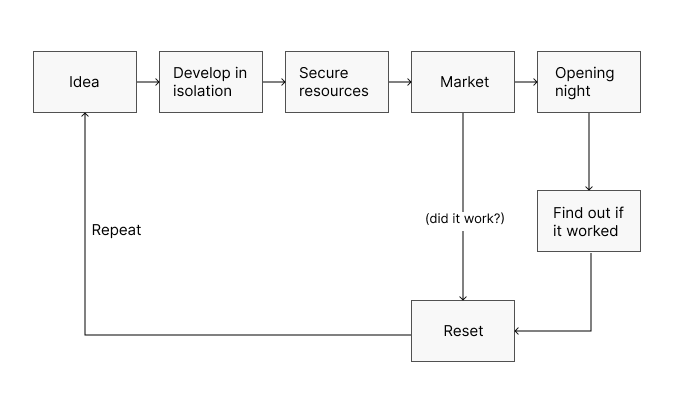
Most performing arts professionals make creative decisions the same way:
This isn’t a failure of talent. It’s hiding your process instead of turning it into audience experience.
If you scored 0-40 on the Production Intelligence Readiness Quiz, you’re an Explorer—and you’re not alone. You’re making creative decisions in isolation, missing opportunities to monetize your journey, collaborate efficiently, and validate demand early.
This page will show you:
Explorers are performing arts professionals who:
You’re an Explorer if:
You’re NOT broken. You just don’t have infrastructure to turn process into audience experience yet.
The Hidden Cost:
Why it persists:
The brutal truth: You’re taking 100% of the financial risk with 0% audience involvement. And you’re giving away your most valuable asset: your creative process.

Instead of writing a full script in isolation and booking a venue…
You turn your development into audience experience:
Option 1: The “Process Journal” (Monetize)
Launch a 3-part email series about the theme you’re exploring—charge $5 for access.
Option 2: The “True 20 Feedback Loop” (Validate)
Post one question online or send one email:
“What scares you about work exploring grief?”
The signal:
The decision: If you can’t get 50 people curious about the idea or willing to pay $5 for process access, you won’t fill 200 seats for the production.
So you either:
You just:
What it is:
Reach out to 20 people who’ve supported your work before (friends, past ticket buyers, artistic peers). Turn your concept development into dialogue.
What you ask:
“If I were making a show about [Theme X], what’s the ONE thing you’d be afraid to see?”
Why this works:
Time: 30 minutes
Cost: $0
What you get: Story angles based on real human emotion + audience involvement early
What it is:
A 3-part email series about the theme you’re exploring—charge $5-10 for access. Turn your development into monetizable content.
The paradigm shift:
Your rehearsal notes, concept explorations, and development questions ARE valuable content. People will pay to be involved in your journey.
The signal:
The decision:
If you can’t get 50 people to pay $5 for process access, you won’t fill 200 seats at $30 for the production.
Time: 2-3 hours to write 3 emails
Cost: $0 (use free email tools like Beehiiv)
What you get: Pre-revenue + proof of concept before you commit 6 months
What it is:
Post 3 different frames of your concept on social media. Invite audiences into your decision-making.
Example frames:
Track:
The paradigm shift question:
Add: “Would you pay $5 to attend a live Q&A where I share my development process for this concept?”
The decision:
The frame that generates the most intent becomes your marketing angle. If 30% say yes to the $5 Q&A, that’s monetization validation for your process.
Time: 30 minutes
Cost: $0
What you get: A data-backed hook + process monetization signal
Goal: Identify 20 people who will give you honest feedback + test if they’d pay for process access
Action steps:
Success metric: 10+ responses with specific language you can use + 3-5 saying “yes, I’d pay”
Goal: Launch your first monetizable process experience
Action steps:
Success metric: 10-20 people pay → $50-300 pre-revenue from your process
Goal: Never start from zero again—and have people to monetize your journey with
Action steps:
Success metric: 50-100 owned contacts in 60 days
Goal: Generate $500-1,000 from your production process (BEFORE opening night)
Action steps:
Success metric: 50 people × avg $10 = $500 pre-revenue from your journey
Email Collection & Sending
Process Monetization
Live Sessions (Turn Process Into Experience)
Total cost: $0-$20/month to start
The mistake: “If I made a show about grief, would you come?”
Why it fails: People lie to be polite. You get false positives.
Better questions:
Why this works: You get honest answers + test if your process has value.
The mistake: “I’ll start monetizing my process once I have a big list.”
Why it fails: You never start. And you miss years of pre-revenue.
Better approach: Start with 20 people. Monetize with 50. Scale to 100.
Why this works: 20 people paying $5 = $100. That’s $100 you didn’t have by hiding alone.
The mistake: “No one wants to see my rehearsals. They only want the final show.”
Why it fails: Your TRUE fans want to be part of your journey. You’re giving away your most valuable asset.
Better approach: Test it. Offer behind-the-scenes access for $5. See who says yes.
Why this works: Substack, Patreon, and OnlyFans prove people pay for process. Your creative journey is content.
The mistake: You develop alone, then have nothing to share.
Why it fails: You miss the opportunity to monetize your journey and build an audience along the way.
Better approach: Document EVERYTHING:
Why this works: Your process becomes content. Content becomes community. Community becomes revenue.
You’re ready to graduate to Builder if:
You might need Pioneer-level infrastructure if:
The Explorer track is perfect if:
No. It makes you look transparent—and monetizable.
The fear: "Artists should reveal finished work, not expose process."
The reality: Substack writers make $5,000/month sharing their writing process. Patreon creators make $50,000/year sharing their development. Your process has value.
Reframe it:
Start with 5.
The True 20 is aspirational. If you only know 5 people who've engaged with your work, start there.
But commit to growing it:
In 6 months, you'll have 50. In 12 months, 200.
That's the best possible outcome.
You just saved yourself 6 months and $15K.
The point isn't to get validation. The point is to get truth before you commit.
If 20 people aren't excited, 200 won't be either. Better to find out now.
Look for patterns, not individuals.
Don't change direction based on one person. Change based on repeated themes.
You just learned the most valuable thing: pivot early.
Testing doesn't guarantee success. It guarantees you won't waste time on concepts with no demand.
If nothing lands:
The goal isn't to validate everything. The goal is to find what resonates.
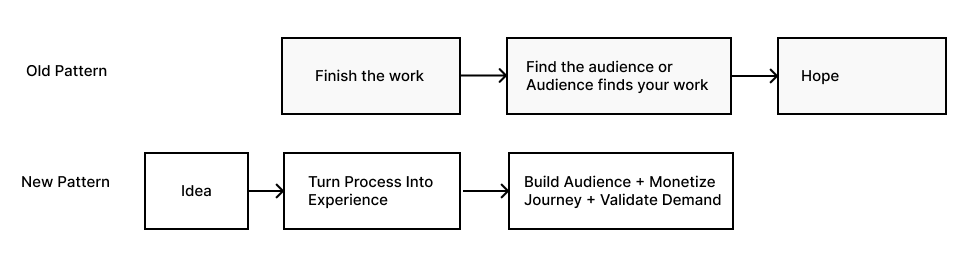
The old paradigm:
Hide backstage → Finish the work → Reveal on opening night → Hope people come
The new paradigm:
Turn process into audience experience → Monetize your journey → Build owned audience → Validate demand → Generate revenue BEFORE opening night
But simple ≠ easy.
The hardest part isn’t the experiment. It’s the mental shift:
Here’s the reframe:
You’re not broken. You’re just building infrastructure to turn process into product.
Every Pioneer started as an Explorer. Every Builder was once starting from zero.
The difference isn’t talent. It’s whether you monetize your journey or give it away for free.
You’re learning to turn your production process into audience experience.
And that’s the shift that changes everything.
What you get:
Best for: Explorers who want peer support and structure
Perfectionism disguised as professionalism is killing performing arts careers. You don’t find a niche—you become it by documenting your process, building community early, and validating demand before opening night.
They taught you the final product is all that matters. That belief is bankrupting talented artists. Here’s what actually builds sustainable creative careers.
For leaders making six-figure decisions—reduce creative risk, align stakeholders, and forecast demand before budgets are locked.

For marketers and producers turning existing audiences into early signals—move from reacting to ticket sales to guiding decisions with evidence.

For artists and teams validating ideas for the first time—learn how to test audience interest early, before committing time, money, or creative energy.