Production Intelligence Readiness Quiz
Contents
You have infrastructure. Email lists. Staff. Past productions. Data everywhere.
But you’re running on a treadmill—and missing your biggest opportunity.
The pattern:
If you scored 41-70 on the Production Intelligence Readiness Quiz, you’re a Builder—and you’re stuck in Reactive Optimization.
You’re not guessing like the Explorers. You’re reacting—which somehow feels worse.
Because you know something isn’t working… you just don’t know until it’s too late to fix it. And you’re giving away 8-12 months of potential revenue from your production process.
Builders are performing arts professionals who:
You’re a Builder if:
You’re NOT lazy. You just don’t have infrastructure to turn your production process into audience experiences at scale.
The brutal truth: You’re managing outputs (clicks, impressions, opens) instead of leading indicators (intent, willingness to pay, emotional resonance).
And you’re missing revenue: Your production process (planning, rehearsals, development) is valuable content people would pay for. But you’re giving it away for free—or hiding it entirely.
Your dashboards tell you what happened. They don’t tell you how to monetize your journey or consolidate your scattered tools.
Builders don’t need more tools.
They need a different sequence.
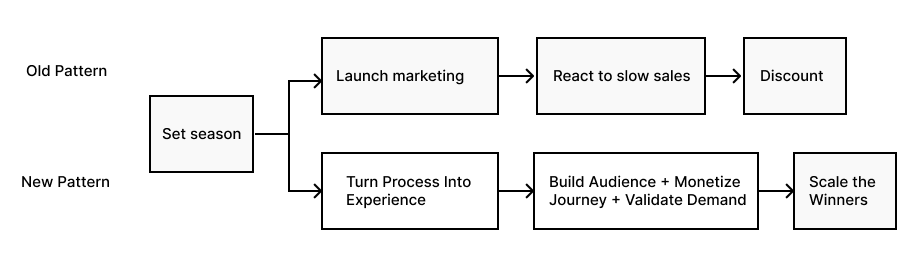
This is how you move the moment of truth earlier—while you still have leverage.
Instead of a generic “Season Announcement” blast (hoping people buy tickets), you turn your season planning into audience experience:
Step 1: Test 3 Concept Frames
Send 3 different Concept Teasers to 3 segments of your list:
Track:
Step 2: Monetize Your Planning Process (The Paradigm Shift)
Add this to all 3 variants:
“We’re inviting 100 people into our season planning process. For $5, you’ll get:
The signal + revenue:
The decision: You shift 70% of your marketing budget toward the angle that already showed high intent—AND you generated $1,500 before opening night.
You just turned season planning from overhead into audience experience + revenue + validation.

What it is: Pull your last 3 email campaigns. Analyze what language drives intent—AND identify which production phases you could monetize.
What to do:
Why this works: Opens don’t buy tickets—intent does. The language that generates clicks is the language that generates sales.
AND: The questions people ask reveal what they’d pay to experience. “How did you choose that actor?” → They’d pay for casting access.
Time: 60 minutes What you get:
What it is: Test 3 different frames for the same show. Track which drives the most intent. Then monetize the interest.
Process:
Time: 2-3 hours setup, 48 hours test What you get:
What it is: Map your 12-month production timeline and identify every audience touchpoint you could monetize.
Process:
Time: 2-3 hours to map, 1 week to test What you get:
What it is: Document every tool your team uses. Calculate time wasted on coordination. Map to unified workspace.
Process:
Time: 3-4 hours audit, 2 weeks test What you get:
Goal: Learn what language in your past campaigns actually drove intent + identify monetization opportunities
Steps:
Success metric:
Goal: Validate which frame resonates BEFORE you commit budget—and test process monetization
Steps:
Success metric:
Goal: Know who in your list actually buys tickets—and launch your first monetized process experience
Steps:
Success metric:
Goal: Predict ticket sales BEFORE you panic—using both validation signals and process revenue
Steps:
Success metric:
Goal: Move from 12 scattered tools to unified workspace
Steps:
Success metric:
Email & Segmentation
Process Monetization
Survey & Intent Testing
Total cost: $50-200/month depending on scale
The mistake: “Our open rates are 40%! We’re doing great!”
Why it fails: Opens don’t correlate with sales. You’re optimizing the wrong metric.
Fix: Track click-through rate and replies asking to buy. These predict revenue.
The mistake: “We’ll monetize the final show. The process is just overhead.”
Why it fails: Your production process IS valuable content. Fans want to be involved. You’re giving away revenue.
Fix: Test one monetized process experience. Charge $10 for behind-the-scenes. See who pays.
The mistake: Blasting the same message to everyone
Why it fails: Your “High Intent” buyers get the same message as your “Low Intent” lurkers. You dilute your best opportunities.
Fix: Tag your list. Send targeted messages to High Intent first. Offer them process access first (they’ll pay).
The mistake: “We use the best tool for each function”
Why it fails: Context switching wastes 10-20 hours/week. “Did you see my email?” becomes daily ritual. Can’t scale.
Fix: Consolidate to unified workspace. Test Attractr (designed for performing arts) or Notion.
The mistake: A/B testing subject lines 2 weeks before opening
Why it fails: Even if you find a winner, you don’t have time to pivot strategy.
Fix: Test concepts 8-12 weeks out. That’s when you can still change direction.
You’ve outgrown Builder if:
The Builder track is perfect if:
After 3 Months:
After 6 Months:
After 12 Months:
Get access to:
The difference between a risky season and a confident one is rarely talent. It’s timing.
Audience Lab helps you move the moment of truth earlier.
The difference between a risky season and a confident one is rarely talent.
It’s whether you:
Audience Lab helps you make all three shifts.
Perfectionism disguised as professionalism is killing performing arts careers. You don’t find a niche—you become it by documenting your process, building community early, and validating demand before opening night.
They taught you the final product is all that matters. That belief is bankrupting talented artists. Here’s what actually builds sustainable creative careers.
For leaders making six-figure decisions—reduce creative risk, align stakeholders, and forecast demand before budgets are locked.

For marketers and producers turning existing audiences into early signals—move from reacting to ticket sales to guiding decisions with evidence.

For artists and teams validating ideas for the first time—learn how to test audience interest early, before committing time, money, or creative energy.