Audience Lab By Attractr

System Builder – Your Systems Got You Here, But They’re Keeping You Stuck

Your System Builder diagnosis: Overcome growth plateaus and generic engagement with 4 steps to smarter systems, AI workflows, and vibe marketing.

Written by
Read time
Updated date

Breaking Through the Growth Bottleneck

You’ve built a well-oiled machine: shows planned months in advance, marketing tools humming, grants secured, CRM organized, maybe even a successful community program or two under your belt.

But growth? It’s plateaued. Audience engagement is dipping. New ideas aren’t landing the way they used to.

Your team is pushing harder than ever—perfecting campaign headlines, syncing calendars, sending follow-ups. And yet, results are flat. Innovation feels out of reach, and your system—once your superpower—now feels like a cage.

If this sounds familiar, you’re likely a System Builder: an organization that’s scaled successfully with strong infrastructure but now faces a wall.

You don’t need to tear it all down. But you do need to reframe what your system is optimizing for.

Haven’t taken the 2-minute audit yet?

Take it now and discover your archetype—it’s the best way to get personalized next steps.

The Real Bottleneck: Systems Built for Yesterday

Your tools, workflows, and content plans were designed for a different digital era—an era when a slick brochure or single season launch could do the job. But audiences today demand more than consistency—they crave connection, personalization, and participation.

  • You’re prioritizing output over connection. Your content is consistent, but it’s a one-way broadcast. 

  • You’re speaking to everyone, not someone. Generic messaging falls flat when audiences crave tailored experiences.

  • You’re collecting data but not using it. Your CRM is a goldmine, but if it’s just a digital filing cabinet, it’s not fueling growth.

  • You’re leaning on old playbooks. Strategies that worked five years ago—like relying on social media reach or recycling the same campaign structure—aren’t cutting it.

  • You’re chasing vanity metrics. Likes and followers feel good, but real traction comes from referrals, repeat ticket buyers, and fans who advocate for you.

The Big Organization Dilemma

You might already sense what’s missing, but organizational roadblocks make change tough:

  • Lengthy approval processes slow down experimentation.

  • A “perfection” mindset clings to the old belief that “if you launch it, they’ll come.”

  • Silos between teams—like production and marketing—prevent collaboration to reach the right audiences.

  • Lack of a unified marketing stack makes it hard to coordinate with promoters or venues.

Teamwork is the heart of a successful production, but without a culture, system, or workflow to orchestrate it, even the best teams struggle. AI is a game-changer here—not just for creating or editing content at low cost, but for building systems and workflows that empower your team to shine.

Welcome to the Age of Vibe Marketing

Today’s most successful brands—from Spotify to Heinz—aren’t scaling through traditional advertising. They’re using vibe marketing: a new form of AI-assisted storytelling that aligns emotional resonance with high-speed content delivery, segmentation, and user feedback.

Coined by creators like Greg Isenberg and inspired by “vibe coding” from AI leaders like Andrej Karpathy, vibe marketing turns brands into living, responsive systems. At its core, it means:

  • Setting a vibe (your emotional brand tone)

  • Listening to micro-signals

  • Building workflows that evolve with your audience

This means you can keep your heart—and gain the agility of a startup.

💡 Brand Case Studies

The examples of Coca-Cola, Spotify, Heinz, and others were inspired by insights from this excellent article on vibe marketing by Penfriend: https://penfriend.ai/blog/what-is-vibe-marketing 

What’s Possible in Performing Arts Marketing

Modern marketing is becoming modular, data-informed, and audience-first. The most compelling growth stories now come from:

  • Micro-campaigns that target segments instead of sending season-wide blasts

  • Real-time personalization that makes newsletters or messages feel one-to-one

  • Fan-driven feedback loops that turn audiences into creative collaborators

  • Low-cost automations that save time for creative, human work

  • AI workflows that can help solo teams compete with full departments

This isn’t “growth hacking” in disguise. It’s marketing that fits the spirit of the arts and the tools of today.

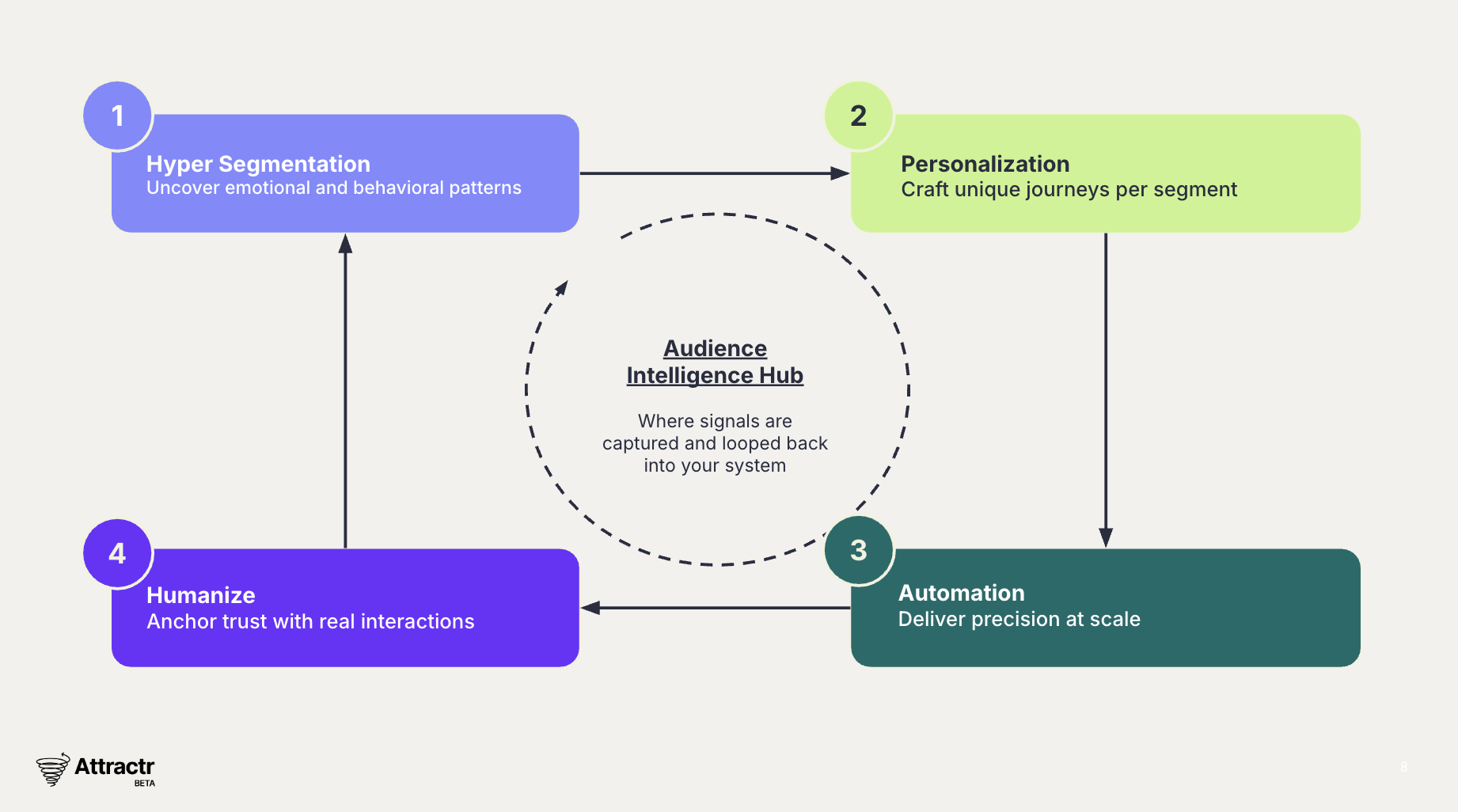
Your Path Forward: Four Steps to Smarter Systems

To unlock your next stage of growth, you don’t need bigger budgets—you need more precision, more relevance, and more feedback loops. These four steps form a modern, AI-powered marketing operating system built for performing arts teams that want to evolve.

1. Segment: Discover Your Audience’s Hidden Tribes

Your audience is not a monolith. They’re clusters of passions, habits, and behaviors waiting to be understood. Hyper-segmentation is the first step to smarter marketing—it allows you to treat each audience segment like its own world.

Why it matters:
Without clear segments, your messaging becomes generic, your campaigns lack focus, and your ROI drops. Segmentation transforms your CRM from a static list into a living map of real people with real signals.

How to do it:

  • Centralize your data from CRM, email, and ticketing platforms using Airtable, Google Sheets, or Notion.

  • Use AI tools (like Claude, Salesforce Einstein, or Klaviyo) to analyze and cluster users based on:

    • Lifetime Value (e.g. high-value donors vs. single-ticket buyers)

    • Preferences & Vibes (e.g. lovers of avant-garde dance vs. fans of classic musicals)

    • Behavior (e.g. frequent attendees, email openers, lapsed fans)

    • Demographics (age, city, income level)

  • Give each segment a clear and actionable name to focus your campaigns.

Example:

  • Urban Millennial Experimentalists

  • High-LTV Traditionalists

  • First-Timers Looking for Deals

If you’re low on data variances, start with a simple 2-minute survey to identify key segments. Then feed that data into a clustering tool to create meaningful personas.

Pro Tip: Make your segmentation dynamic—set up automations so your CRM updates these groups based on real-time behavior.

2. Personalize: Design Journeys That Speak to Each Segment

Once you’ve identified your audience tribes, personalization turns data into action. It’s not just about using someone’s name in an email—it’s about offering the right story, format, timing, and call to action based on their values.

Why it matters:
Personalization boosts engagement because it makes people feel seen. It aligns your mission with your audience’s motivations—and creates journeys that feel human, not scripted.

How to do it:

  • Match content to each segment’s vibe (e.g., bold visuals for Experimentalists, archival videos for Traditionalists).

  • Craft micro-offers—small, low-friction calls-to-action that are tailored to each group (e.g., “Join our backstage Q&A” or “Gift a ticket to a young artist”).

  • Map the full journey—from the first interaction to post-show engagement—and optimize touchpoints around behaviors and emotional moments.

Example:

  • An intro email for Lapsed Fans might say: “We haven’t seen you in a while. Here’s what’s new—and a code to welcome you back.”

  • For High-Value Donors, a post-show email could offer a personalized thank-you and sneak peek at the next season.

3. Automate: Free Up Time Without Losing the Human Touch

Your team doesn’t need more tasks—they need smarter tools. Automation helps you scale your efforts while staying lean. But done right, it’s not robotic—it’s responsive.

Why it matters:
When your tools take care of the repetitive tasks, your team can focus on strategy, creativity, and meaningful connection.

How to do it:

  • Use platforms like Zapier, Gumloop, or Make.com to automate:

    • Tagging: Automatically tag frequent attendees, donors, or lapsed users based on behavior.

    • Follow-ups: Trigger thank-you emails, special offers, or reminders based on milestones.

    • Lead scoring: Prioritize high-value contacts for personalized outreach.

Example Automations:

  • When someone attends 3 shows in a season, tag them as “Loyalist” and send a loyalty reward.

  • If someone RSVPs but doesn’t attend, send a gentle re-engagement email with a behind-the-scenes clip.

  • Score and surface high-value leads for your development team weekly.

4. Humanize: Anchor Your Strategy in Real Connection

AI and automation help you scale—but soul still sells. Your audience doesn’t just want relevance; they want realness. Humanization is about creating genuine moments that reflect your voice, mission, and care.

Why it matters:
Trust is built through human connection. Authentic moments foster emotional loyalty and word-of-mouth growth.

How to do it:

  • Use your segments to drive real-world experiences: Invite your most passionate fans to exclusive events, panels, or input sessions.

  • Leverage AI for personalization—but keep it human: Tools like Tavus can send personalized video invites, but your script and tone should feel like you.

  • Gather feedback often: Let audiences co-create experiences with you.

Examples:

  • Invite Dance Enthusiasts to a choreographer Q&A via Zoom.

  • Let Community-Driven Donors vote on a community initiative or name a new program.

  • Send a short, sincere video from your artistic director to First-Timers, welcoming them personally.

Pro Tip: The best “vibe marketing” moments don’t feel like campaigns. They feel like care.

Where Attractr Fits Into the Vibe

Attractr is still in its MVP phase—but even now, we’re building with one clear mission:
To help performing arts creators and organizations build smarter, more human systems for audience growth.

Here’s how we see Attractr becoming part of your vibe marketing ecosystem:

1. Shared Audience Assets: Unlock Your Collective Network

Attractr makes it easy to aggregate and grow a shared audience database with your creators and collaborators.
Each time a creator hosts a Live Room or adds a cast/crew credit, new members join your ecosystem—bringing their preferences, behaviors, and creative DNA with them.

With user segmentation (coming soon), production companies will be able to see not just who their audience is, but what makes them tick—giving you the foundation for true personalization, powered by vibe.

Your CRM shouldn’t just be a spreadsheet. It should be a living map of your creative community.

2. Live Rooms: Make It Human Again

Unlike passive content formats—like YouTube lives or Instagram stories—Live Rooms are designed for two-way interaction.
They offer a lightweight space for creators to host Q&As, behind-the-scenes talks, alumni panels, or drop-in sessions that bring fans inside the process.

Whether you’re featuring a Legacy Builder, a first-time choreographer, or a show marketing lead, Live Rooms deepen connection without requiring expensive studio setups or full-on production cycles.

It’s where digital meets human—without the hustle.

3. Clara AI: Understand Audience Intent with Feedback Loops

Your audience is talking. Clara AI is here to help you listen—and act.
This upcoming feature turns casual survey data into intelligent insights, mapping not just what audiences liked, but what they want next—and why.

From pre-show diagnostics to post-show feedback loops, Clara enables production teams to understand audience motivations and respond with precision—informing pricing, messaging, creative direction, and community building.

The result? Less guesswork. More growth. Deeper resonance.

Final Thought

The next level of performing arts marketing isn’t about replacing what works—it’s about augmenting it with audience insight, emotional clarity, and smart, nimble systems.

Attractr can help you test, learn, adapt, and move fast—without losing your artistic soul.

Keep Building with Audience Lab

Your Blueprint is just the beginning. Audience Lab gives you simple tools, fresh insights, and a creative community to help you grow without overwhelm.

Stay connected. Keep learning. Build smarter.

Next up in Next Move Series